Longchamp

Longchamp

A brand book with no system logic. 13 weeks later: 80+ components, 24 markets, zero localisation debt.

Role

Lead · DS Architecture · Solo

Challenge

Brand book. No system logic.

Scope

Tokens · Components · RTL · Intl

Impact

80+ components. 24 markets. 13 weeks.

01 · Situation

A beautiful brand. No system to deploy it with.

Longchamp had a strong brand identity developed by an external branding agency. Visually precise, emotionally coherent — but built without any notion of design system. No tokens, no components, no documented logic. Just a brand book.

The challenge was not redesigning the brand. It was transforming a static visual identity into a living, scalable design system deployable across 24 markets, 7 languages and RTL contexts — in 13 weeks, embedded directly within Longchamp's organisation.

01

Brand book only

A visually strong identity with no system logic, no tokens and no component thinking

02

24 markets

International deployment requiring RTL adaptation and 7-language support from day one

03

No baseline

Integration team had no shared design language to build against

04

13 weeks

Full architecture, documentation and handoff in a timeline that left no room for iteration

The real challenge

The brand existed. The system had to be invented from scratch.

02 · Approach

One architecture. Three delivery tracks.

The only way to deliver 24 markets in 13 weeks was to get the architecture right before touching a single component. Speed came from structural clarity, not from working faster.

Token architecture

Tension

A brand with values. No variables.

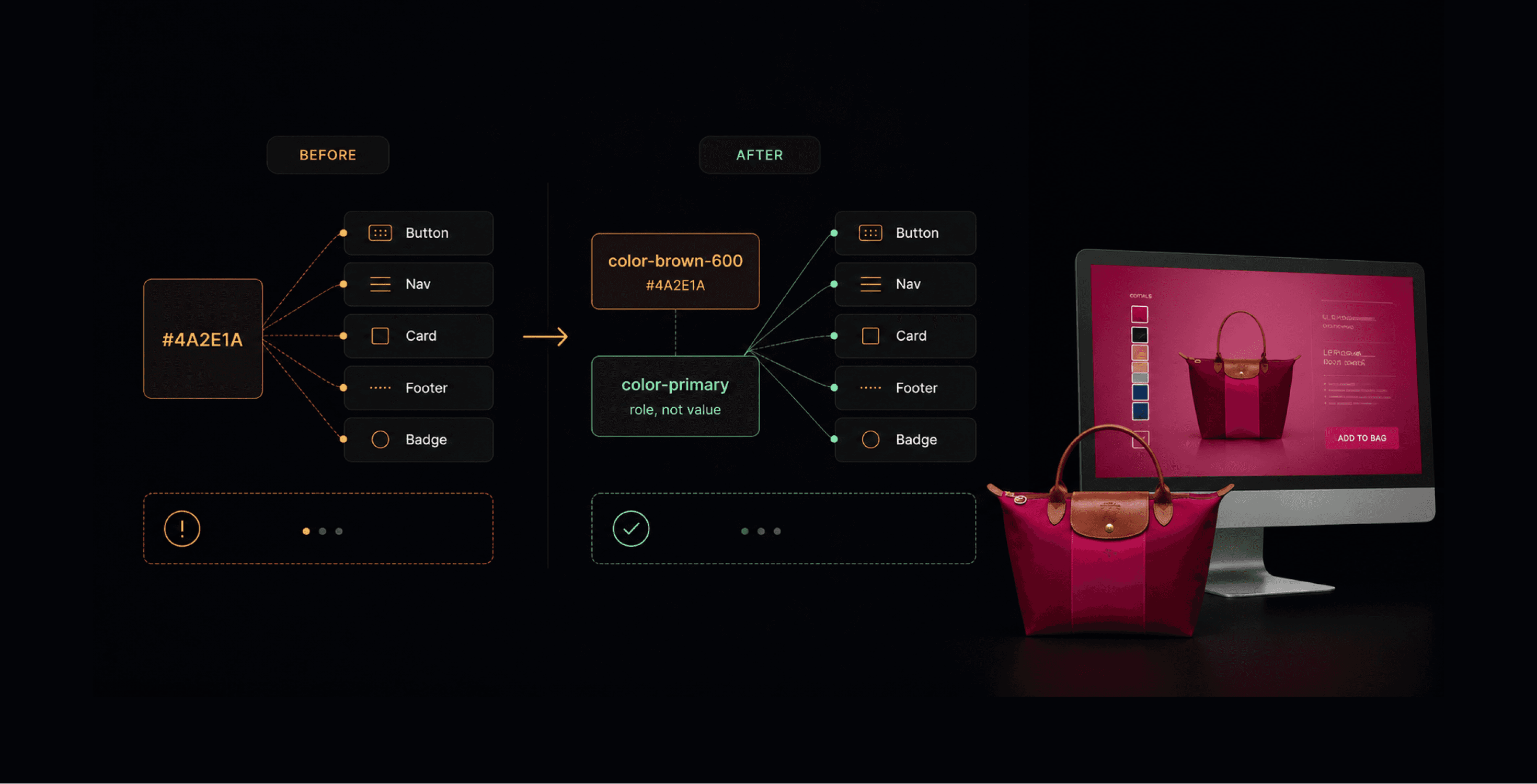
The branding agency had made precise visual decisions — spacing, colour, typography, elevation. But none of it was documented as a system. Every value existed as a one-off choice, not as a token that could be referenced, overridden or localised.

Call

Extract the logic. Build a 2-level token architecture.

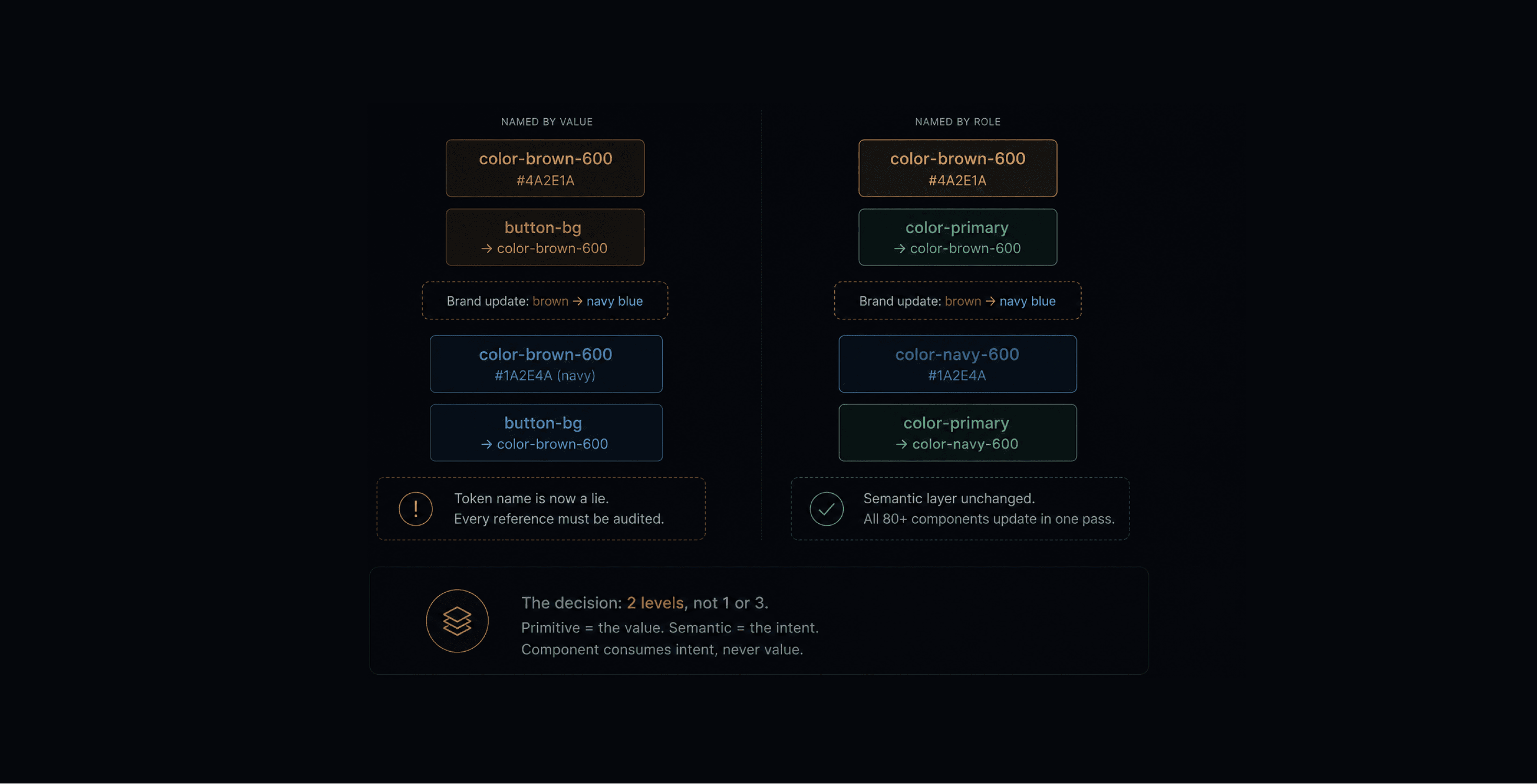
Every visual decision from the brand book was formalised into a two-level token structure: primitive tokens defining raw values, semantic tokens mapping those values to usage contexts. Figma variables made the system navigable for the integration team from day one.

Result

Brand book → operable token system.

The token layer became the single source of truth for all downstream decisions. Components built on semantic tokens inherited brand updates automatically. The integration team could build against JSON exports without interpretation friction.

Component library

Tension

No baseline. 80+ components to build.

Without an existing design system to extend, every component had to be designed from the ground up — atoms, molecules, organisms — while staying faithful to a brand identity that had never been designed for product contexts.

Call

Atomic design. Full variant coverage. No exceptions.

The library was built on strict atomic principles with no shortcuts on variant or state coverage. Every component shipped with default, hover, focus, error, disabled and loading states. Annotations were written for the integration team in parallel, not after delivery.

Result

80+ components. Documented. Deployable. No debt.

The library was delivered with zero undocumented components. Every decision was traceable to a token. The integration team could build any Longchamp surface without ambiguity or interpretation.

International adaptation

Tension

A system built for French. A brand deployed everywhere.

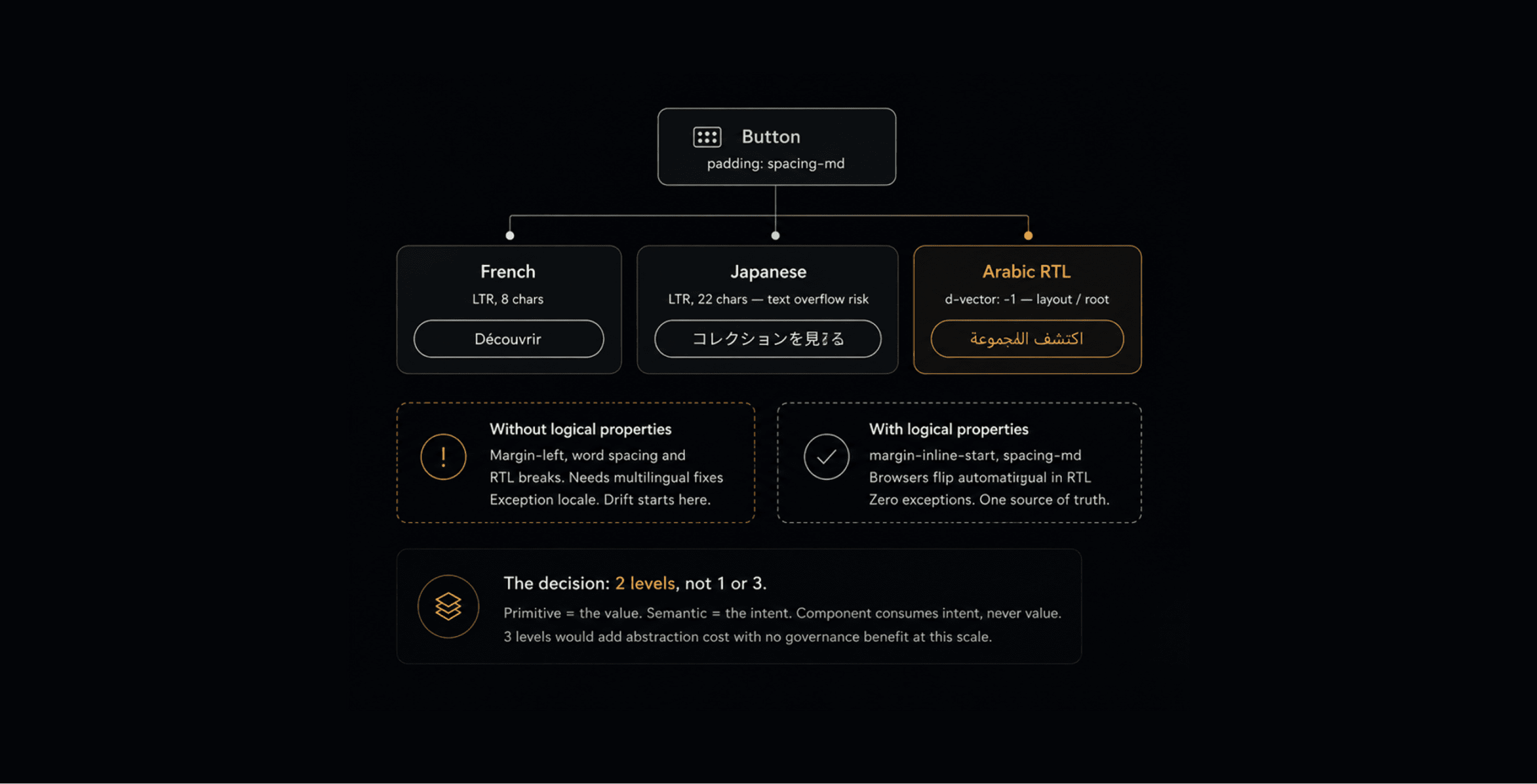
Longchamp's international footprint required more than translation. Arabic and Hebrew markets needed full RTL support. 7 languages introduced variable text length constraints that had to be stress-tested against every component.

Call

Design for the hardest context first.

RTL adaptation was treated as a first-class design constraint from the start, not a post-delivery patch. Components were designed bidirectionally from the token level up. Text length stress-testing across all 7 languages was embedded into QA at component level.

Result

One system. 24 markets. Zero localisation debt.

The international deployment ran without market-specific patches. RTL markets launched on the same component library as LTR markets. The system absorbed language and directional variation by design, not by exception.

Take away

Speed at scale comes from architecture, not from working faster.

03 · Outcomes

What 13 weeks produced.

Architecture was the only deliverable that mattered. Everything else scaled from there.

BeforeAfter

Brand book. No system logic.

2-level token architecture

No component baseline

80+ documented components

No RTL or language support

24 markets. 7 languages. Zero debt.

Integration team building blind

JSON token exports. No friction.

full delivery

13w

token architecture to international deployment

components

80+

documented, full variant and state coverage

markets

24

deployed on a single shared system

localisation debt

0

RTL and 7-language support built in from day one

04 · Takeaways

Three things this confirmed.

01

Getting the architecture right is faster than working fast. Token layer first — everything else scales from there.

02

RTL is not a localisation task. It is a design constraint. Treat it last and you pay twice.

03

Embedded solo design removes translation friction. Decisions made in the room where delivery happens.

Closing

The brand was the input. The system was the work.

A brand book with no system logic. 13 weeks later: 80+ components, 24 markets, zero localisation debt. Architecture was the only deliverable that mattered.