AskNiels

AskNiels

Turning a strategic design methodology into an operational AI-powered experience platform.

Role

Co-founder · Product · Design · Dev

Challenge

Methodology trapped in documents.

Scope

Knowledge · AI · UX · Workflows

Impact

57 activities. −54% delivery. 1 system.

01 · Situation

A strong methodology is useless if teams cannot activate it.

Niels had a rich strategic design methodology. Its value depended entirely on people being able to understand it, navigate it, apply it and reuse it across contexts. The challenge was not documenting the method. It was turning it into an operational experience system.

The real risk was the usual one: knowledge trapped in documents, interpretation left to individuals, consistency dependent on who was in the room. The opportunity was to make the method available, navigable and actionable at scale — without reducing it to generic AI output.

01

Trapped knowledge

57 activities, multiple phases and use cases — valuable but inaccessible without expert guidance

02

Consistency gap

Method interpretation varied across coaches, clients and internal teams

03

AI risk

Generic AI would dilute the doctrine and produce noise instead of methodological value

04

Activation gap

Knowing the method existed and being able to use it were two entirely different things

The core decision

Treat the method as a product, not as documentation.

02 · Approach

Three tracks. One operating system.

The only way to make the method operational was to design it as a product from the ground up — knowledge architecture first, AI behavior second, platform logic third.

Knowledge architecture

Tension

The method existed. It was not queryable.

Niels' methodology was rich and precise, but it lived in documents and human memory. Before an AI assistant could be useful, the entire corpus had to be restructured into a format that was machine-readable, semantically consistent and faithful to the original doctrine.

Call

Structure the corpus before building the interface.

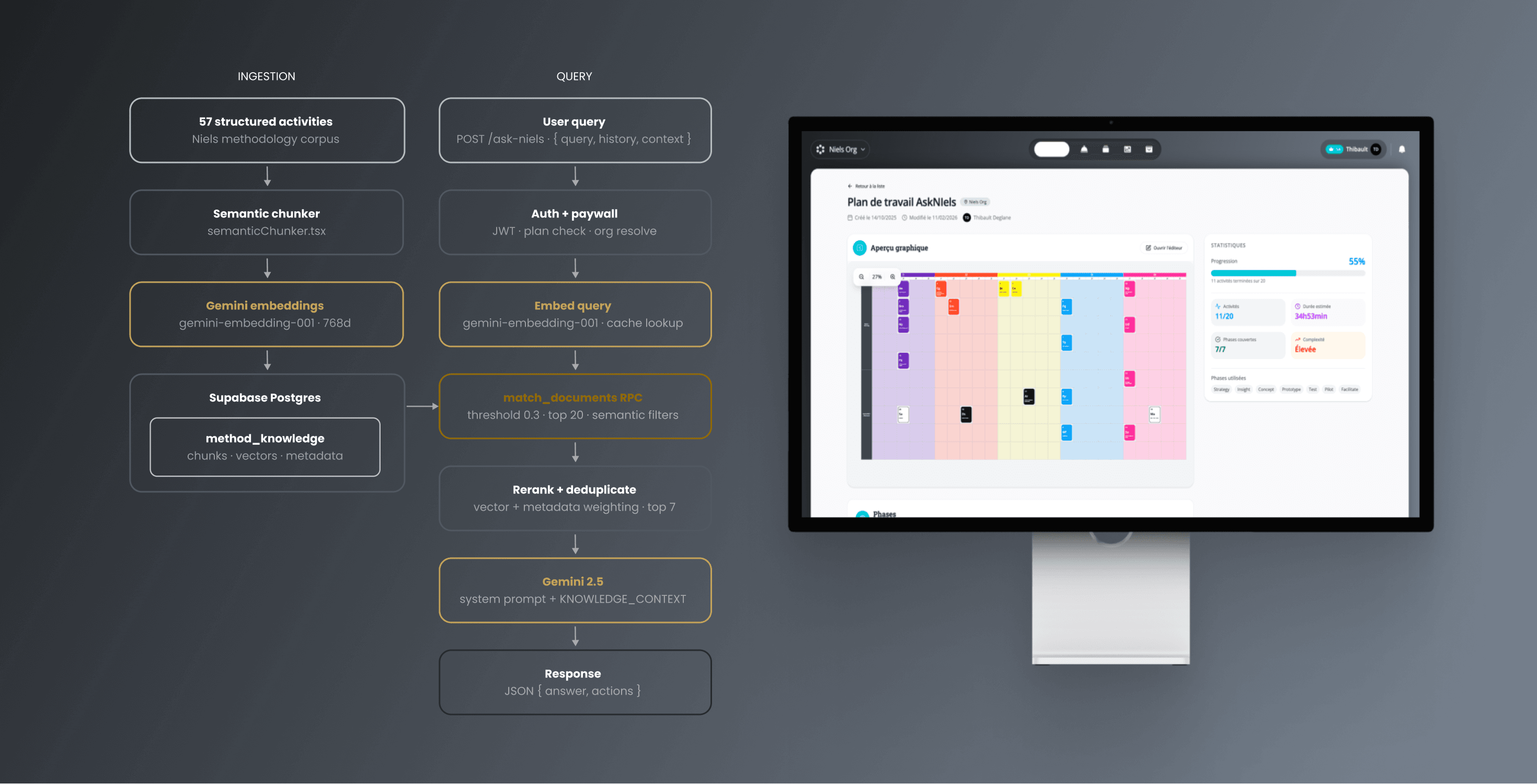
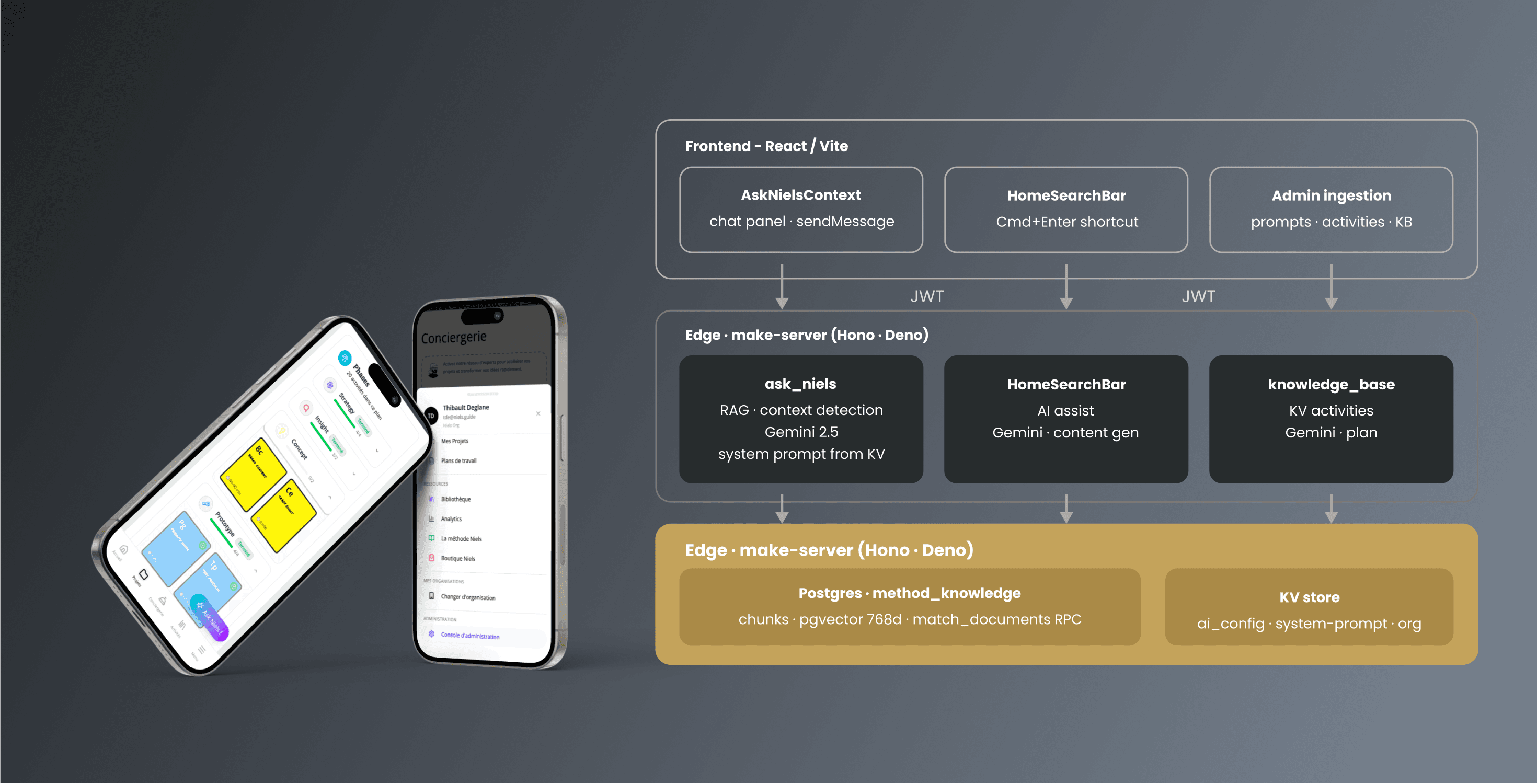
All 57 activities were deconstructed and rewritten as structured knowledge units — each with context, use cases, decision criteria and expected outputs. Chunking strategy, embedding logic and retrieval architecture were designed to surface the right activity for the right context, not just the closest keyword match.

Result

57 activities. One queryable, doctrine-faithful corpus.

The knowledge architecture became the foundation everything else was built on. Doctrinal guardrails were embedded at the corpus level to prevent the assistant from producing generic design advice dressed up in Niels vocabulary. Quality of output was determined by quality of structure.

AI experience design

Tension

AI without doctrine produces noise.

The default behavior of a general-purpose AI is to be helpful in the broadest possible sense. For AskNiels, that was a failure mode. An assistant that produced plausible-sounding design advice without methodological grounding would undermine the entire value proposition.

Call

Define the behavior model before the interface.

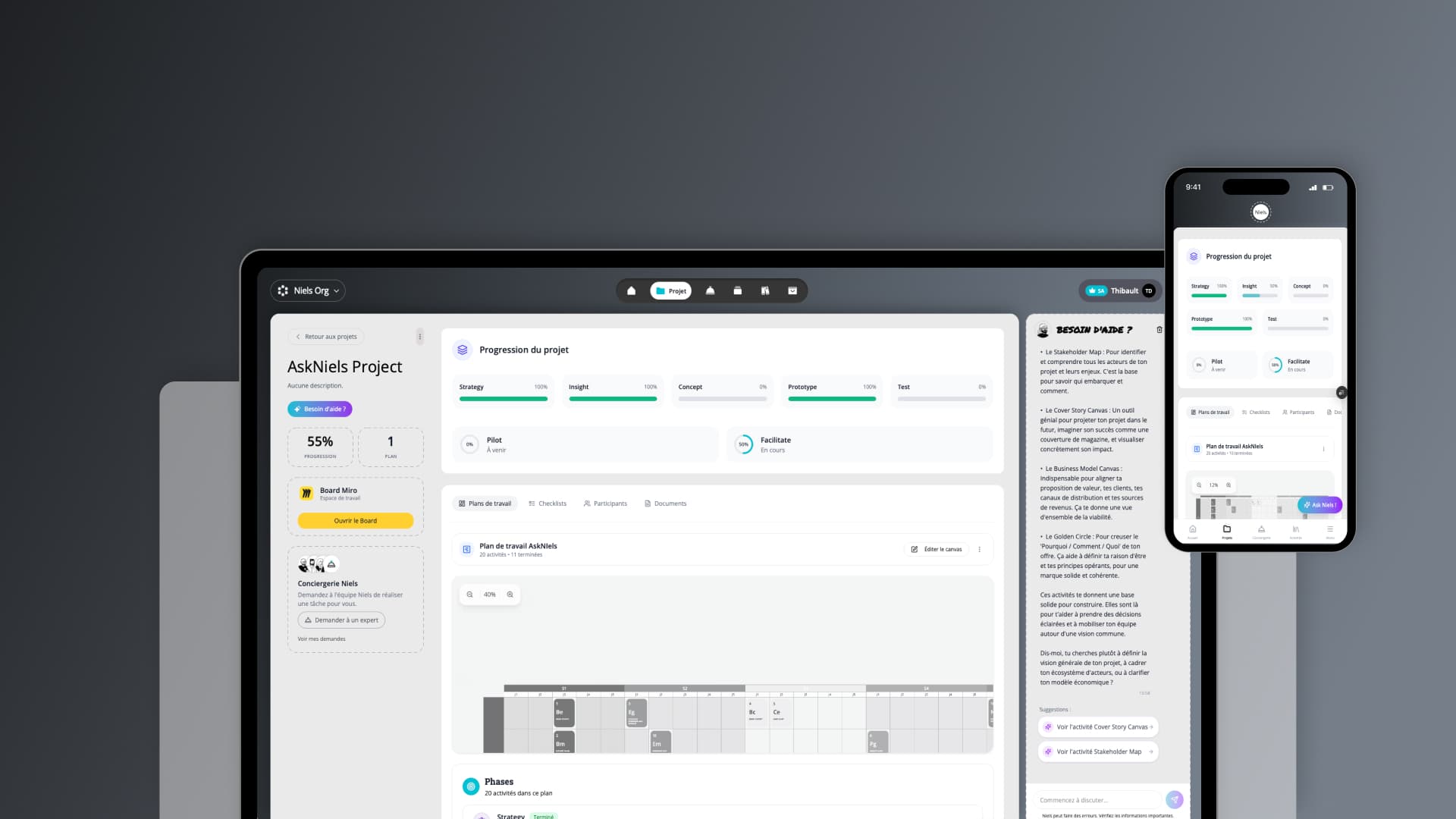
The assistant's behavior was designed explicitly: context before output, operational answers over inspirational content, method-faithful recommendations over generic best practice. Response principles were documented and tested against real coaching scenarios. The interaction model was built around four modes: understand, recommend, guide, produce.

Result

An assistant that activates the method. Not one that replaces it.

The AI behavior model became the governance layer of the product. Every response had to help a user decide, prepare, facilitate or produce something concrete. Answers that felt smart but were not actionable were treated as bugs, not features.

Platform & workflows

Tension

Different users. Different maturity levels. One system.

AskNiels had to serve coaches who knew the method deeply, clients who had never seen it, and learners trying to build fluency. A single interface serving all three contexts without degrading the experience for any of them required explicit workflow design, not just a search box.

Call

Design for usage scenarios, not for features.

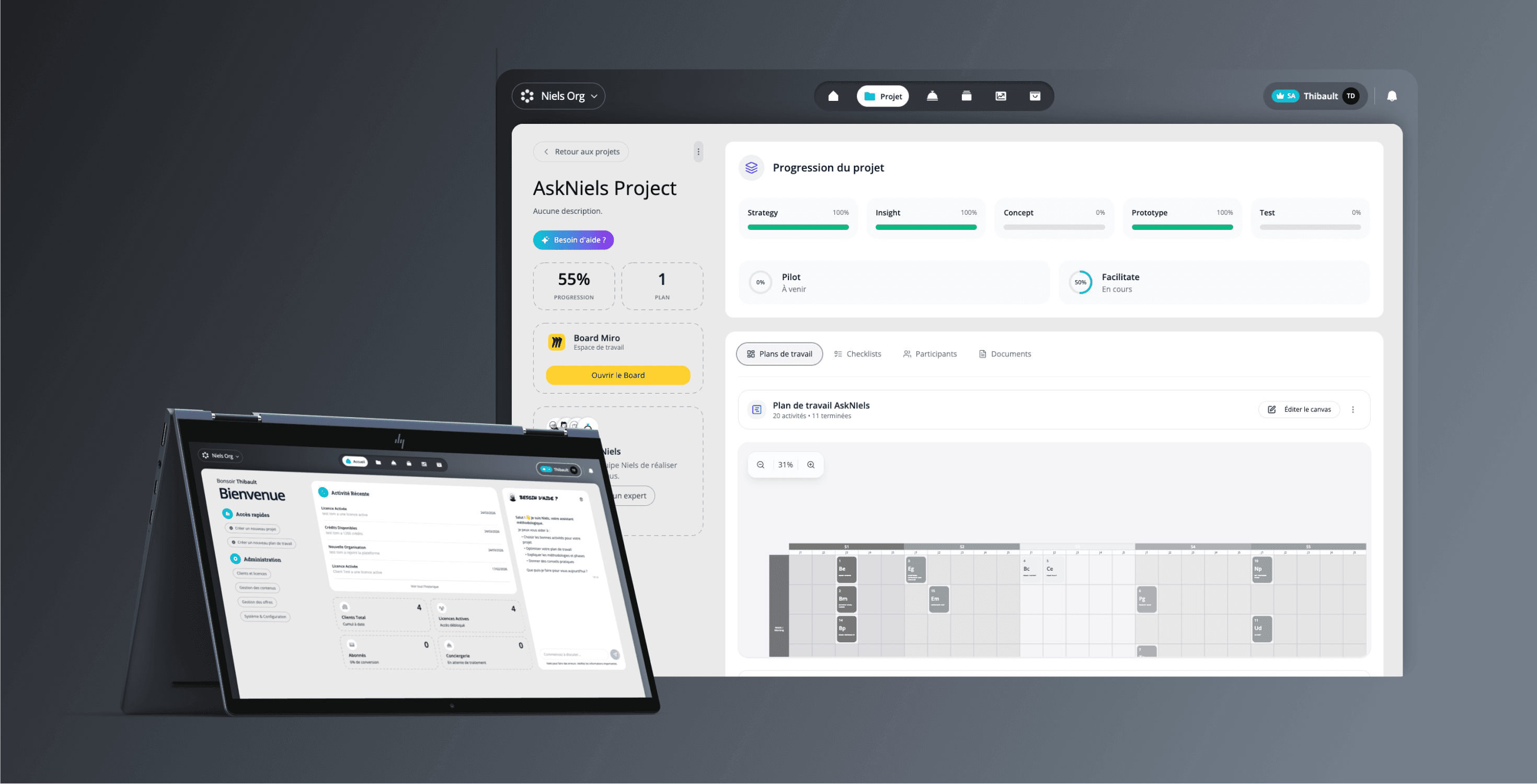
Five core usage scenarios were defined and designed: understand the method, choose an activity, prepare a workshop, adapt a framework, generate structured outputs. Each scenario had its own interaction logic, response format and success condition. The platform UX was built around these scenarios, not around feature completeness.

Result

Reusable workflows across coaching, learning and consulting.

The platform became operational across multiple usage contexts without requiring customisation for each. Coaches prepared workshops faster. Clients accessed the method without needing an expert in the room. The system scaled the methodology beyond the people who originally held it.

Take away

AI amplifies what is structured. It cannot replace what is not.

03 · Outcomes

What became operational.

No artificial performance metrics. The proof is system performance: structured corpus, governed AI behavior and measurable delivery acceleration.

BeforeAfter

Methodology trapped in documents

57 activities in a queryable corpus

Generic AI answers

Doctrine-faithful guardrails

Expert-dependent knowledge

Self-serve AI-assisted workflows

Delivery bottlenecks

−54% on operational tasks

delivery time

-54%

on selected operational tasks using AI-assisted workflows

activities

57

structured into a queryable, doctrine-faithful RAG corpus

doctrinal

Guardrails

AI behavior governed to stay faithful to the Niels methodology

usage contexts

3

coaching, learning and consulting served by one platform

04 · Takeaways

Three things this confirmed.

01

AI amplifies what is structured. The quality of the output was directly proportional to the quality of the knowledge architecture. Prompt engineering is a surface fix. Structure is the real lever.

02

Behavior design is product design. Defining how an AI assistant should think, prioritise and respond is not a technical task. It is a design task — and it determines whether the product is useful or just impressive.

03

Productizing expertise is a different discipline. Turning a consulting methodology into an operational platform required moving from knowledge transfer to system design. The method did not change. The way it could be accessed did.

Closing

From method to product. From expertise to system.

AskNiels is not a chatbot. It is a productization effort: turning design expertise, methodology and operational knowledge into an experience system that scales across people, projects and contexts. Strategic design translated into product logic.