Van Cleef & Arpels

Van Cleef & Arpels

BXP diagnostic framework identifying four buyer profiles across 5 markets. AVA Digital Awards Platinum.

Role

Lead · Strategic framing · BXP

Challenge

No buyer framework across markets.

Scope

Research · BXP · Strategy · 5 markets

Impact

4 profiles. 5 markets. AVA Platinum.

01 · Situation

Ultra-luxury brand. No framework to understand how buyers actually experienced it.

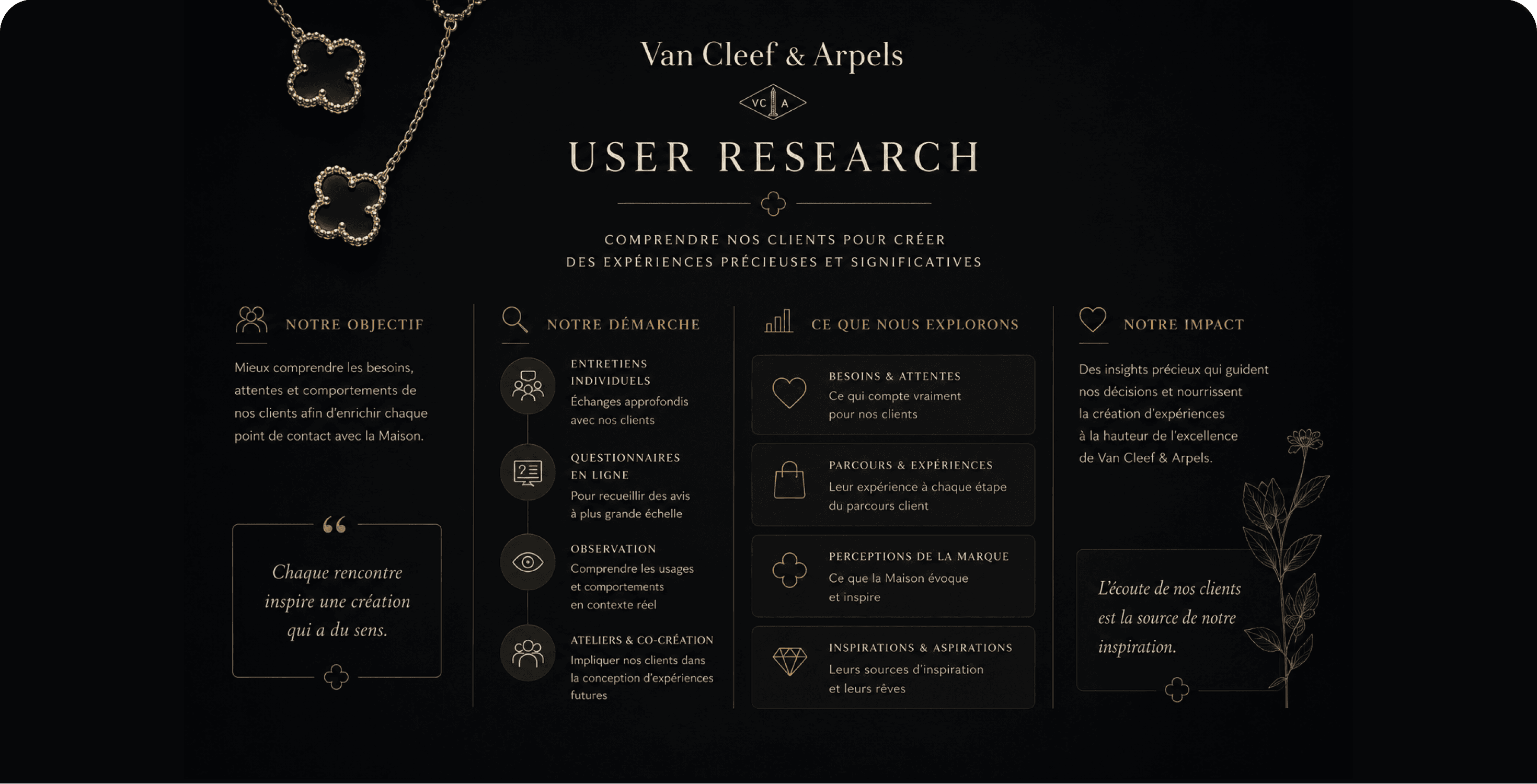
Van Cleef & Arpels had a strong brand and a defined digital presence. What was missing was a structured understanding of how different buyer profiles related to the Maison — their emotional expectations, their purchase motivations and the experience gaps between what the brand offered and what each profile actually needed.

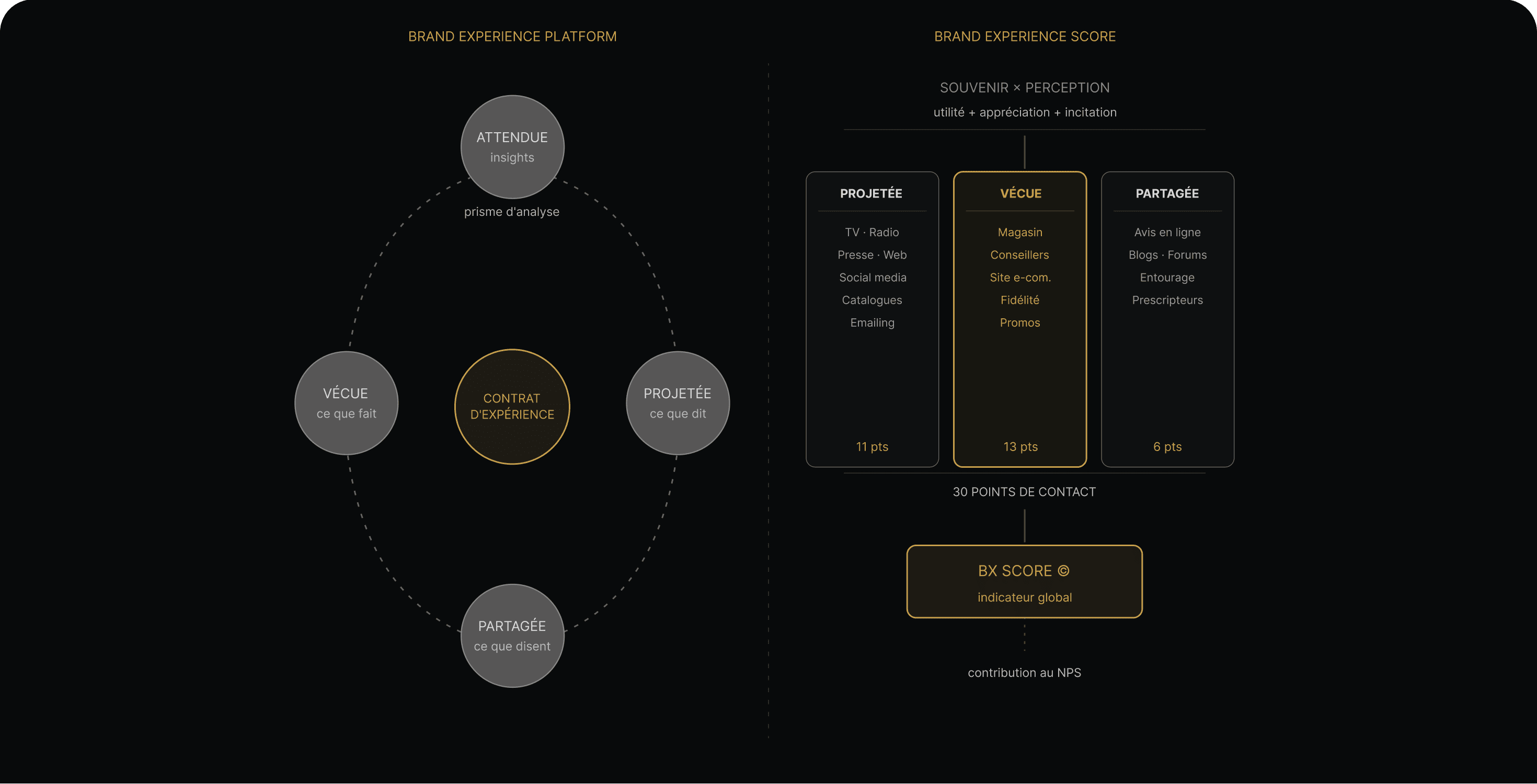
The mandate was to create a Brand Experience Platform framework: a strategic diagnostic tool to map buyer expectations, identify experience opportunities and give the Maison a shared language for experience decisions across 5 markets.

01

No buyer framework

No structured understanding of how different buyer profiles related to the Maison across markets

02

5 markets

Buyer behaviour and expectations varied significantly across geographies — no shared analytical framework

03

Experience gaps

Disconnect between brand promise and actual experience at key touchpoints — unmapped and unaddressed

04

No shared language

Teams across markets had no common framework to discuss and prioritise experience decisions

The design challenge

02 · Approach

Diagnose before designing.

The BXP work was strategic before it was experiential. Understanding the buyer landscape, formalising the profiles and mapping the experience gaps had to come before any experience recommendation.
Buyer profile framework

Tension

Different buyers. No common way to talk about them.

Van Cleef & Arpels attracted buyers with fundamentally different relationships to the Maison — from highly initiated collectors with deep brand knowledge to aspirational first-time buyers navigating the ultra-luxury context for the first time. Without a formalised profile framework, every market team was making experience decisions based on a different implicit buyer model.

Call

Identify and formalise four buyer profiles from the BXP analysis.

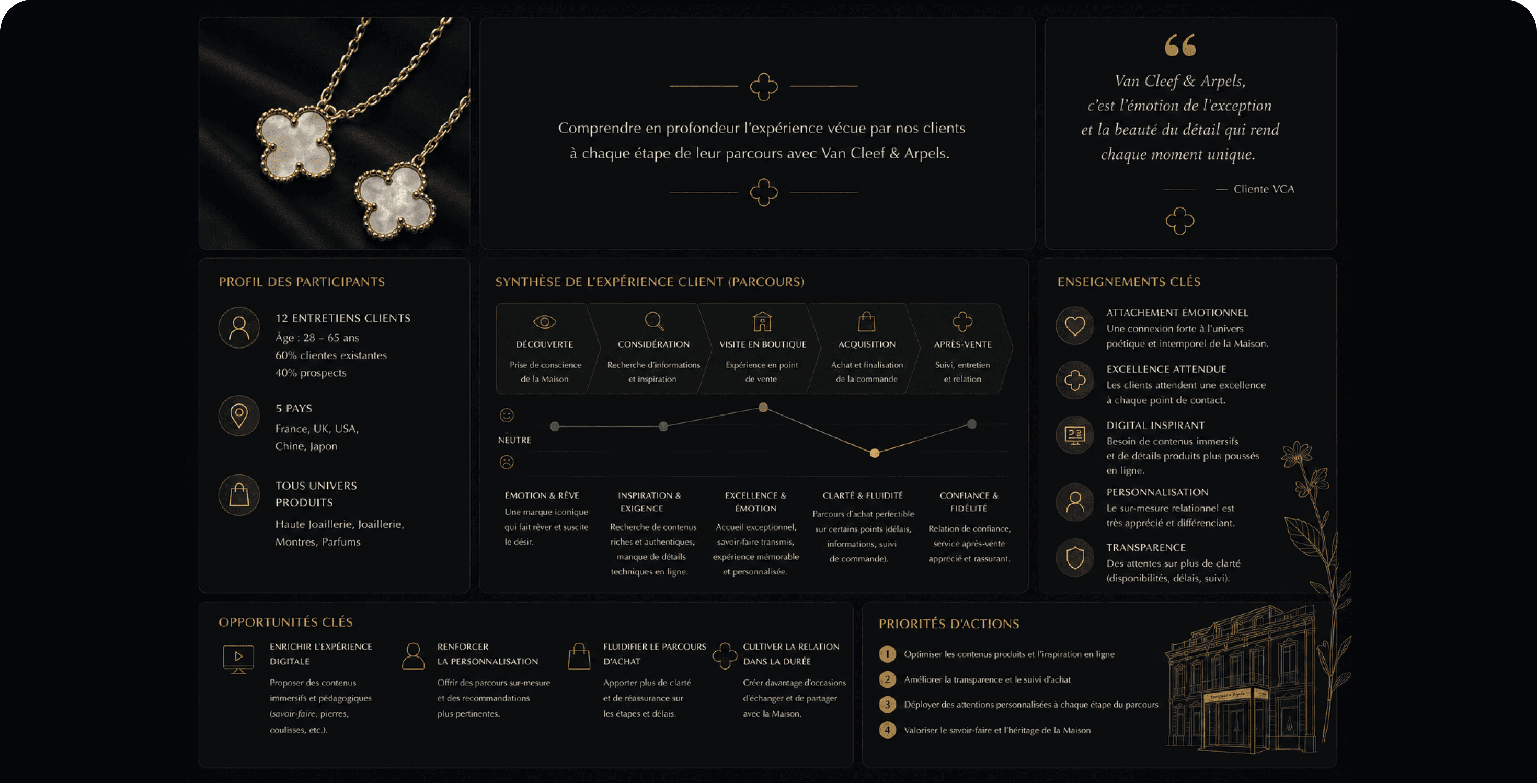
The four buyer profiles were identified and formalised from the BXP analysis, based on luxury purchase motivations, emotional expectations and relationship to the Maison. Each profile was documented with its decision triggers, experience expectations, emotional drivers and key touchpoints — giving the Maison a consistent language for experience decisions across markets.

Result

Four profiles. One shared framework across 5 markets.

The buyer profile framework gave Van Cleef & Arpels teams in 5 markets a common analytical language. Experience decisions could now be evaluated against specific buyer expectations rather than a generalised luxury consumer model.

Experience gap analysis

Tension

Brand promise and experience reality were not always aligned.

The gap between what Van Cleef & Arpels promised as a brand and what different buyer profiles actually experienced at key touchpoints was unmapped. Without this understanding, experience improvements were being made without prioritisation logic.

Call

Map the gaps between promise and experience for each buyer profile.

The BXP diagnostic mapped the experience reality against the brand promise for each of the four buyer profiles across the key touchpoints — digital discovery, consideration, purchase and post-purchase relationship. Gap severity and opportunity value were assessed for each profile and market.

Result

A prioritised map of experience opportunities across 5 markets.

The gap analysis gave Van Cleef & Arpels a structured, evidence-based view of where experience investment would have the highest impact for each buyer profile — replacing assumption-driven decisions with a framework grounded in actual buyer expectations.

BXP strategy

Tension

Market teams making experience decisions without a shared strategic framework.

Without a governing BXP strategy, market teams were making experience decisions independently — creating variation in brand experience quality and missing opportunities for cross-market learning and coherence.

Call

Create a BXP framework that works as both a diagnostic and a governance tool.

The BXP framework was designed to serve two purposes: as a diagnostic tool for analysing current experience performance, and as a governance framework for future experience decisions. Experience principles derived from the buyer profiles gave teams a consistent decision-making language across markets.

Result

AVA Digital Awards Platinum. A framework adopted across 5 markets.

The BXP work was recognised with an AVA Digital Awards Platinum. More significantly, it gave Van Cleef & Arpels a strategic framework that teams across 5 markets could use to align experience decisions with specific buyer expectations.

Take away

03 · Outcomes

What the framework produced.

Strategic clarity before experience design. A framework that created shared language and prioritised experience investment across 5 markets.

BeforeAfter

No buyer framework across markets

4 profiles. Emotional mapping.

Experience decisions by assumption

Gap analysis. Evidence-based priorities.

No shared language across markets

1 BXP framework. 5 markets aligned.

buyer profiles

4

identified and formalised from BXP analysis across 5 markets

markets

5

aligned on a single buyer experience framework

AVA Digital Awards

Platinum

recognition for the BXP framework and approach

shared language

1

experience decisions aligned across all markets

04 · Takeaways

Three things this confirmed.

01

Strategic frameworks are design outputs. The BXP work produced a buyer profile framework and a gap analysis — not screens or components. That is design work at its most valuable: creating the conditions for better decisions.

02

Shared language is a governance mechanism. A framework that gives 5 market teams a common way to discuss buyer expectations is not just a research output. It determines the quality of every experience decision made after it.

03

Ultra-luxury experience design requires emotional precision. The difference between buyer profiles in this context is not demographic — it is motivational and emotional. Getting that mapping right changed the prioritisation logic entirely.

Closing

The framework was the deliverable.

Van Cleef & Arpels demonstrated that the most valuable design work in ultra-luxury is often invisible to the end consumer. The BXP framework did not produce a new interface — it produced a shared understanding of who the Maison was designing for and what each buyer profile actually needed from the experience.