
Askniels project
Building the operating system of a methodology
year
2026
timeframe
2 years
tools
Figma Cursor Gemini
category
AI - UX - UI - REACT
View it Live

Most innovation projects share the same failure pattern. Not a lack of ideas — a lack of structure to turn them into something real. Teams spend weeks aligning on a vision that keeps shifting. Workshops produce insights that never make it past a sticky note. Momentum dies between sessions.
The question Niels had been answering for years, project after project, was simple : how do you make good ideas inevitable rather than accidental ?
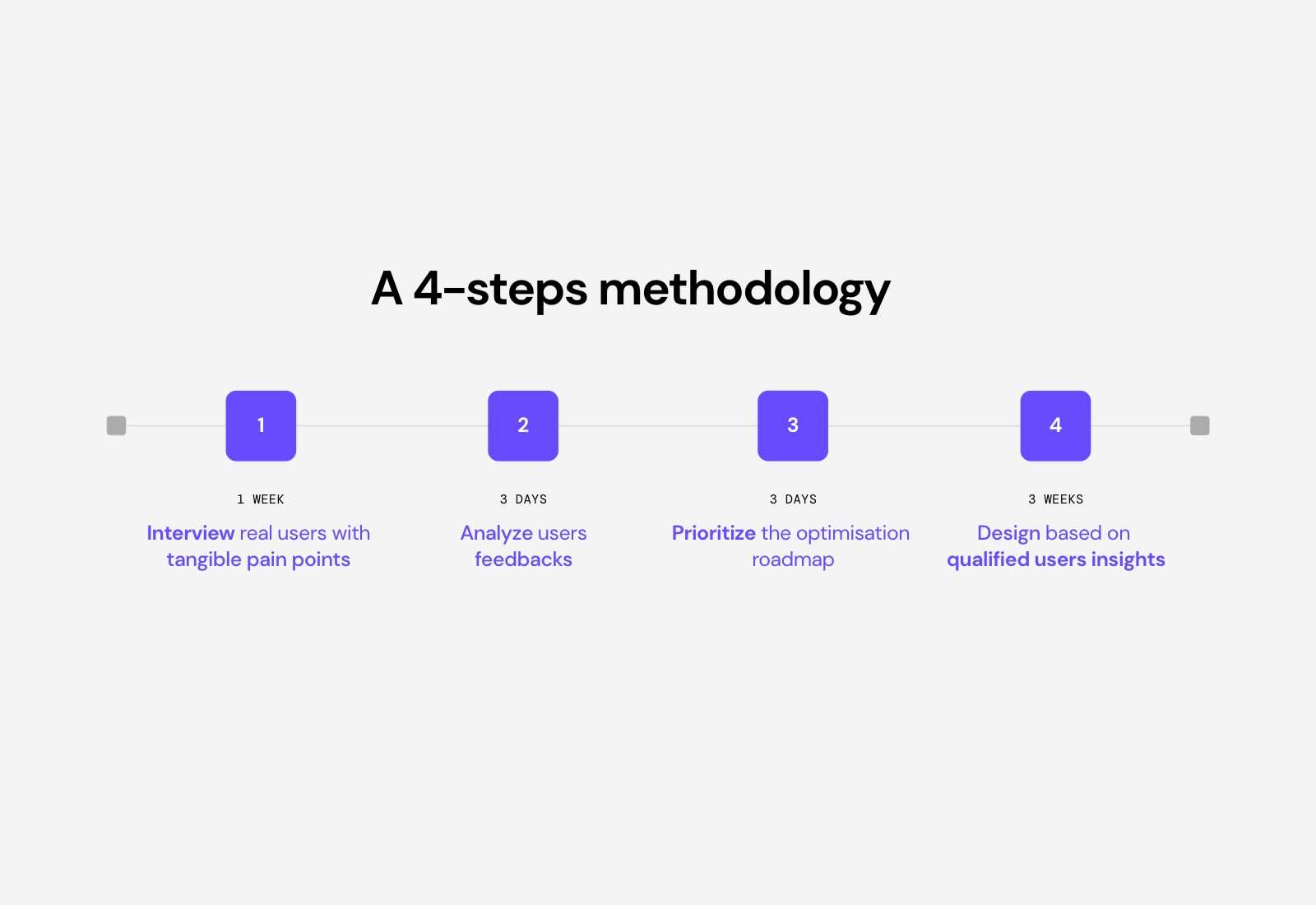
The answer was a methodology. The next question was harder — how do you put that methodology inside a tool ?
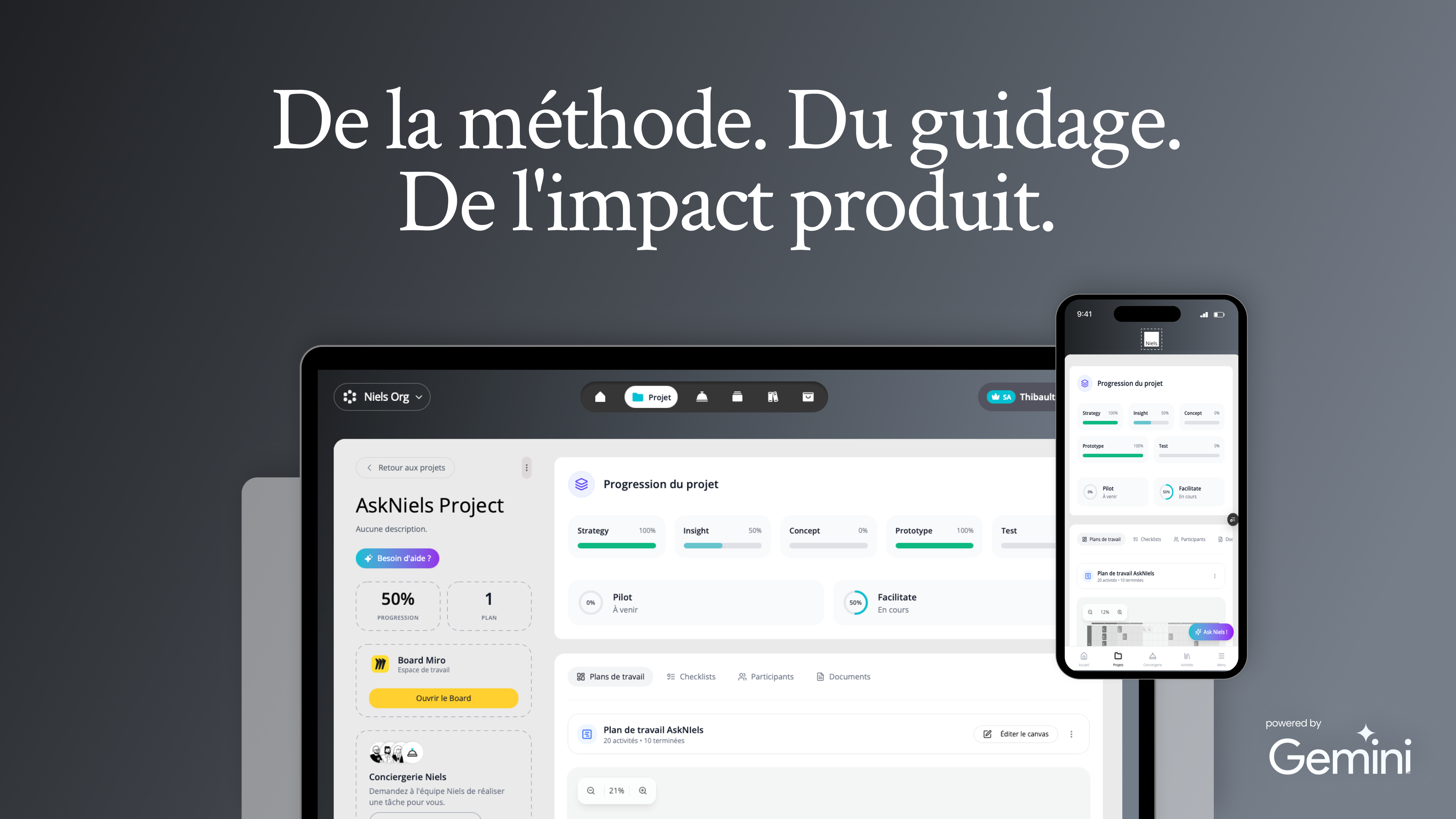
Ask Niels is a project platform built around emotional strategy — designed to compress the distance between a rough idea and a working concept, between a team misaligned and a team moving in the same direction.
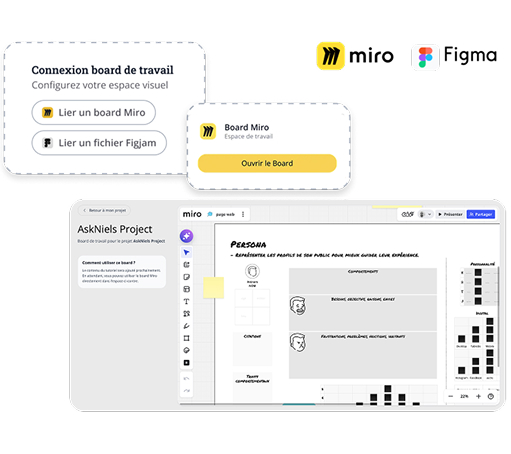
It gives project teams a shared visual workspace, 57 structured activities organised by phase, and an AI assistant that knows the method well enough to guide — not just suggest.
The result is a platform where strategic rigour and creative velocity stop being trade-offs.
From blank canvas to delivery, faster
The core design challenge wasn't building features. It was making a complex methodology feel effortless to use mid-project.
A team in the middle of an ideation sprint doesn't want to stop and read documentation. They need the right activity at the right moment, assembled into a workplan that reflects where they actually are — not a generic template that forces them into a process that doesn't fit.
The Plan Builder was designed around this tension. A visual, drag-and-drop canvas where teams compose their own project arc from structured methodological activities — seeing the full shape of a project at a glance, adapting it as the work evolves. Not a rigid framework. A living structure.
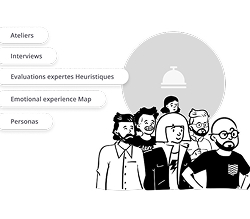
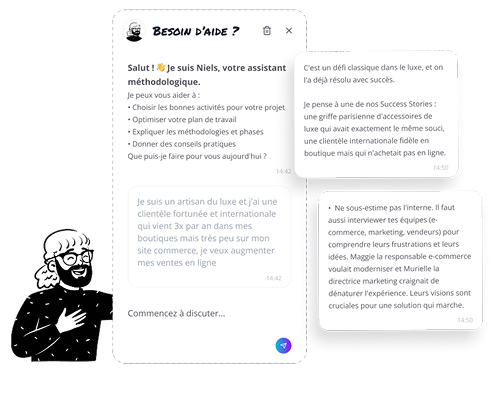
The AI assistant sits inside that workspace, context-aware, trained on the method. When a team hits a decision point, it doesn't redirect them to a knowledge base. It meets them where they are.
−54%
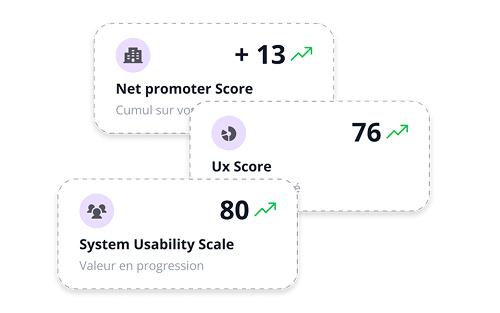
time to project delivery
57
structured activities, ready to use
06
project phases, fully integrated
97
Lighthouse score
WHAT THE FIELD CHANGED
- The first Plan Builder gave teams complete freedom from day one. Too much open space created paralysis, not creativity. Starter templates weren't in scope — real usage made them essential.
- Progressive activity discovery replaced the full catalogue view. Exposing 57 activities at once overwhelmed teams mid-project. Surfacing them by phase, at the right moment, changed how teams engaged with the method entirely.
- The AI assistant revealed how much strategic knowledge had never been formalised. Building it forced the kind of documentation that makes a methodology truly transferable.

Askniels project
Building the operating system of a methodology
year
2026
timeframe
2 years
tools
Figma Cursor Gemini
category
AI - UX - UI - REACT
View it Live
Most innovation projects share the same failure pattern. Not a lack of ideas — a lack of structure to turn them into something real. Teams spend weeks aligning on a vision that keeps shifting. Workshops produce insights that never make it past a sticky note. Momentum dies between sessions.
The question Niels had been answering for years, project after project, was simple : how do you make good ideas inevitable rather than accidental ?
The answer was a methodology. The next question was harder — how do you put that methodology inside a tool ?
Ask Niels is a project platform built around emotional strategy — designed to compress the distance between a rough idea and a working concept, between a team misaligned and a team moving in the same direction.
It gives project teams a shared visual workspace, 57 structured activities organised by phase, and an AI assistant that knows the method well enough to guide — not just suggest.
The result is a platform where strategic rigour and creative velocity stop being trade-offs.
From blank canvas to delivery, faster
The core design challenge wasn't building features. It was making a complex methodology feel effortless to use mid-project.
A team in the middle of an ideation sprint doesn't want to stop and read documentation. They need the right activity at the right moment, assembled into a workplan that reflects where they actually are — not a generic template that forces them into a process that doesn't fit.
The Plan Builder was designed around this tension. A visual, drag-and-drop canvas where teams compose their own project arc from structured methodological activities — seeing the full shape of a project at a glance, adapting it as the work evolves. Not a rigid framework. A living structure.
The AI assistant sits inside that workspace, context-aware, trained on the method. When a team hits a decision point, it doesn't redirect them to a knowledge base. It meets them where they are.
−54%
time to project delivery
57
structured activities, ready to use
06
project phases, fully integrated
97
Lighthouse score
WHAT THE FIELD CHANGED
- The first Plan Builder gave teams complete freedom from day one. Too much open space created paralysis, not creativity. Starter templates weren't in scope — real usage made them essential.
- Progressive activity discovery replaced the full catalogue view. Exposing 57 activities at once overwhelmed teams mid-project. Surfacing them by phase, at the right moment, changed how teams engaged with the method entirely.
- The AI assistant revealed how much strategic knowledge had never been formalised. Building it forced the kind of documentation that makes a methodology truly transferable.
Askniels project
Building the operating system of a methodology
year
2026
timeframe
2 years
tools
Figma Cursor Gemini
category
AI - UX - UI - REACT
View it Live
Most innovation projects share the same failure pattern. Not a lack of ideas — a lack of structure to turn them into something real. Teams spend weeks aligning on a vision that keeps shifting. Workshops produce insights that never make it past a sticky note. Momentum dies between sessions.
The question Niels had been answering for years, project after project, was simple : how do you make good ideas inevitable rather than accidental ?
The answer was a methodology. The next question was harder — how do you put that methodology inside a tool ?
Ask Niels is a project platform built around emotional strategy — designed to compress the distance between a rough idea and a working concept, between a team misaligned and a team moving in the same direction.
It gives project teams a shared visual workspace, 57 structured activities organised by phase, and an AI assistant that knows the method well enough to guide — not just suggest.
The result is a platform where strategic rigour and creative velocity stop being trade-offs.
From blank canvas to delivery, faster
The core design challenge wasn't building features. It was making a complex methodology feel effortless to use mid-project.
A team in the middle of an ideation sprint doesn't want to stop and read documentation. They need the right activity at the right moment, assembled into a workplan that reflects where they actually are — not a generic template that forces them into a process that doesn't fit.
The Plan Builder was designed around this tension. A visual, drag-and-drop canvas where teams compose their own project arc from structured methodological activities — seeing the full shape of a project at a glance, adapting it as the work evolves. Not a rigid framework. A living structure.
The AI assistant sits inside that workspace, context-aware, trained on the method. When a team hits a decision point, it doesn't redirect them to a knowledge base. It meets them where they are.
−54%
time to project delivery
57
structured activities, ready to use
06
project phases, fully integrated
97
Lighthouse score
WHAT THE FIELD CHANGED
- The first Plan Builder gave teams complete freedom from day one. Too much open space created paralysis, not creativity. Starter templates weren't in scope — real usage made them essential.
- Progressive activity discovery replaced the full catalogue view. Exposing 57 activities at once overwhelmed teams mid-project. Surfacing them by phase, at the right moment, changed how teams engaged with the method entirely.
- The AI assistant revealed how much strategic knowledge had never been formalised. Building it forced the kind of documentation that makes a methodology truly transferable.